Interviewed by Richard Fawcus.
7 August 2015. Sofia, Bulgaria.
Translation by Mihail Kondov.
First of all, I would like to thank you for making the time to speak with me. It’s quite an honour – not only are you the creator of many of Bulgaria’s most interesting monuments, but having been a partisan yourself during WWII, you’re also the subject of many.
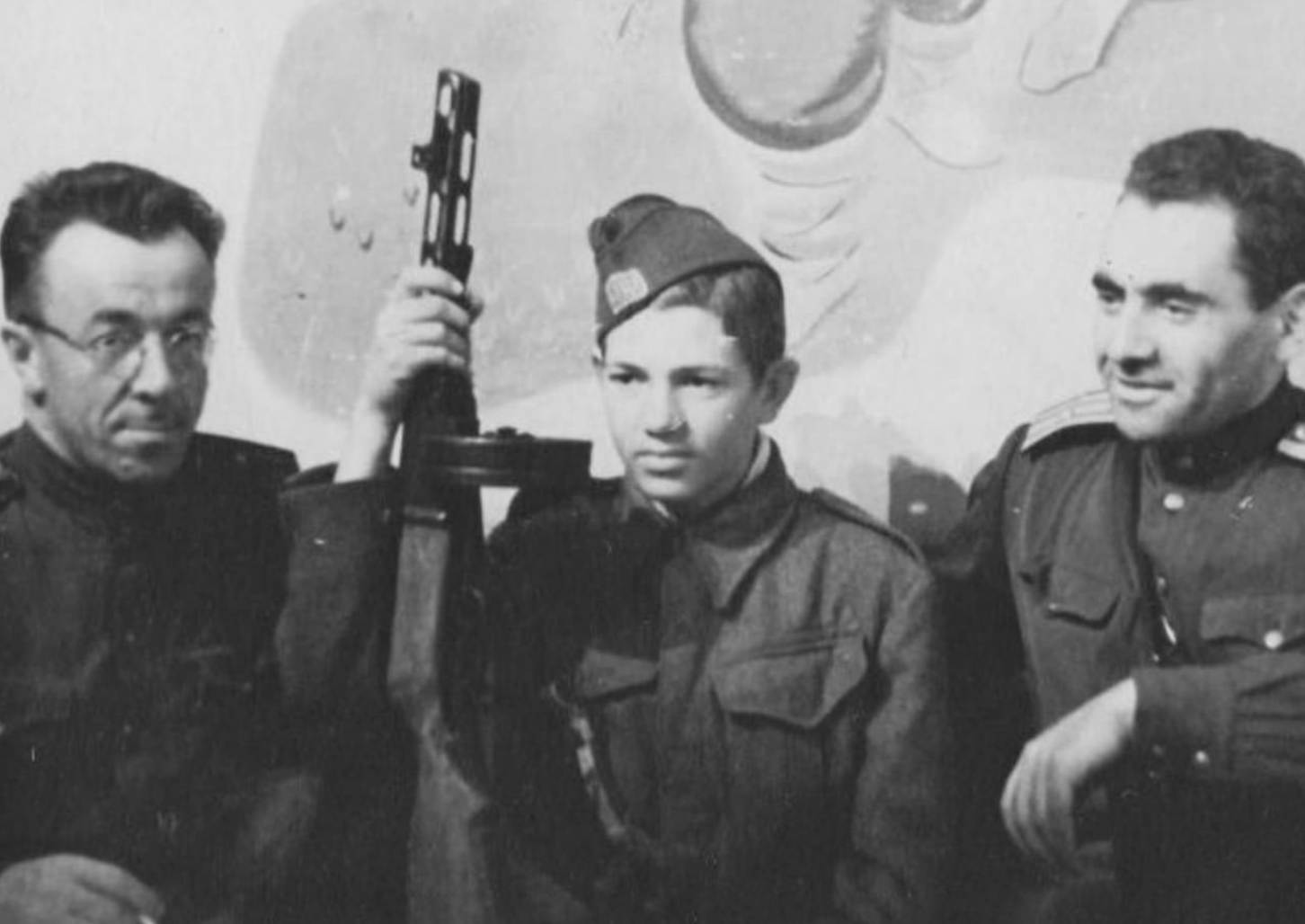
[Laughing] Yes, I was a partisan myself… the youngest partisan in Bulgaria. I was 15 years old then. I served in the First Sofia Brigade with commander Slavcho Transki. I was his courier, but not only that, I was in battles too. We fought Bulgarian fascists. It was 1944 when I became a partisan, along with my mother, father and everybody. This movement had taken hold of the whole country, and it was a just cause indeed.
During your career as an architect, you’ve been responsible for quite a number of monuments around Bulgaria. Which ones were you involved with?
Well, let me see now. You know about Buzludzha, don’t you? I designed one in Dobrich too. And one in Durankulak. Another one in Lovech district, in the village of Stoyanovo. I haven’t been there since we built it, in 1963. I designed the Arch of Liberty at Beklemeto, in the Troyan mountain pass, and another at Gurgulyat about the [1885] Serbo-Bulgarian War.
The pantheon at Gurgulyat is quite unique. It appears almost alien, this great pink pyramid beside a small rural village…
Here’s why it is so… the initial idea was to place it on the hill next to the main road to Yugoslavia… to what is now Serbia. But we were friends at the time, and the Serbs thoroughly objected to the project. They said: How can you speak of the war between us? Get rid of it! And so we moved it further away from the border, away from the historic battlefield.
Your Gurgulyat monument is shaped like a pyramid, while the Mother Bulgaria statue inside has a head like a sphinx. Did you knowingly draw inspiration from Egyptian motifs?
Yes, from the Egyptian and also Mexican pyramids.
There seems to be a running theme of ancient civilisations in your work.
Well, that is true. Architecture needs inspiration and it needs to embrace international themes. Architecture is a world phenomenon, though of course, it also has many national characteristics. In the middle ages and around the revival period, national architecture [in Bulgaria] was greatly developed. But later, it began to grow more uniform. Especially now, when the world is globally united. One can’t come up with ideas that exist completely outside of the world’s traditions. Works need to incorporate elements of quality world architecture. And as you know, I didn’t study in Bulgaria… I studied in Moscow and in Paris.
So you were able to draw inspiration from both the East…
And from the West, correct. In Bulgaria I initially worked for Glavproekt. My first significant work was Hotel Rila, you know it here in Sofia. Near Varna I designed Hotel International, at Golden Sands. A few more hotels as well. After that I was Mayor of Sofia. Then Minister of Regional Planning. Then, as I told you, I was a president of the Bulgarian Union of Architects and later I was elected a president of the International Architects Union.
An impressive resumé!
[Laughs] Also, honorary member of many architecture academies. Later, on my initiative, we created the International Academy of Architecture in Sofia. All in all, this is my biography.
Regarding Buzludzha, the shape is very interesting. So many of the monuments built here during the 1970s – your own, included – feel very masculine, with sharp shapes, squares and angles. Buzludzha feels much more feminine in design, and it seems to mark quite a departure from the monumental architecture that preceded it in Bulgaria.
It was a reflection of the general state of Bulgarian architecture at the time. Bulgarian architecture too, witnessed large-scale transformations, and all in a relatively short period of time. After 9th September 1944, our architecture was entirely classical under the Soviet influence. This classical style is represented by the National Library in Sofia, or the centre of Sofia in general – in the development of which I took part as a student. That was our classical period, neo-classical. Soon after that though, from around 1960, we began to pursue a path of world architecture. We were looking at things built by Gropius, Mies van der Rohe, Le Corbusier, and so on. This is the period that you accurately call more crude, masculine. By the 1980s though, we couldn’t just remain in the same place. We couldn’t keep making these big squares, and so forth. We began seeking out modern architecture.
How much of this change was your initiative? Or were you aware of following a broader trend?
Every architect seeks those changes on his own. Everyone observes what is being done in other countries, what world architecture has to offer, and changes their style accordingly. World architecture was changing, and so Bulgarian architecture changed with it. In fact, our architecture changed before our [communist] government did – we were way ahead of the government when it comes to joining the global community. Our government, as you know, only transitioned in 1989… and that transition is still struggling. At least in terms of architecture though, we are now on the same footing with everyone else, I hope.
Bulgaria features a very broad range of architectural styles today – from traditional village houses, to modernist town squares and futurist mountaintop monuments…
Of course! But you see, architecture has many different genres. One is public housing. Monumental architecture is its own very special genre, and it can never stray too far away from global traditions, from the earliest history up until today. As a result, you have here various ideas incorporated from the Egyptian architectural tradition, or from Mexican history. Or Roman arches, like my arch in the Beklemeto Pass. All sorts of things.
Did your design for Buzludzha also draw on classical inspirations?
[Smiling] In Rome there is a building called the Pantheon. It is 40 metres in diameter… this one is 60 metres.
How did that design come about?
Buzludzha was finished in 1981… but the design contest was announced 10 years before that. My design won it, but the shape of the original project was different. There was a wreath with six supports and a tower in the middle carrying a red star. This was the project that won the first prize. After that, the regional committee of Stara Zagora decided that the Buzludzha monument… well, the contest at that time was actually for four monuments. One monument to Hadzhi Dimitar. The second was a monument to the founders of the socialist movement in Bulgaria. Another one to the Gabrovo partisan regiment, and the last project was to place a ruby star on top of Buzludzha peak. This was the requirement, and my design was the winner in that last category.
They wanted a ruby star specifically?
Yes, with real rubies… Well, real in the sense that these were synthetically produced. But the intention was always to create a quality star. At the time, they made the first three monuments because those projects were comparatively modest. The last project was sort of left aside.
Ten years later, Stara Zagora’s local government decided to finish it, because people were visiting the peak and there was nothing to see there! So they called me and said: You have a monument design that won a contest, let’s build it. I told them however, that what they wanted was difficult. They wanted an interior area so they could hold party gatherings, host speeches there and suchlike. I told them, the project needs to be changed. They agreed that it was my right as author to do so, and so of course, I changed it. The tower was moved to the side. This saucer, this intergalactic saucer echoed popular themes of the era – cosmic, flying saucers. And that’s how Buzludzha came to be.
Where did the construction funds come from?
It was important that the monument should be financially free from the state. In the beginning, Stara Zagora district told us that they had voted for the project, and had successfully secured the money required to construct it. But I said: Alright, so there is money… but the people themselves need to build this monument. The government liked that idea. So they collected donations, made souvenir postage stamps for people to buy, and so on. We managed to raise 16 million levs in total.
And 16 million levs back then was a lot of money.
A lot of money indeed. The actual cost of the monument was 14 million, and the other 2 million went towards the construction of new kindergartens. So, in the end the monument was both ideologically and financially free from the government! It truly was an intergalactic monument of the people.
The design certainly seems to captivate the imagination of visitors. You can go there now, and on any day you’ll meet people from all around the world. Last time I visited I met tourists from Canada, Brazil, Australia…
And not from Bulgaria?
From Bulgaria too. But many people are buying flights and travelling half way around the world just to see this one monument. How do you feel about that?
Well, first, about the appeal of the monument: back at that time Bulgaria was a Warsaw Pact nation. Contact between us and the West was therefore limited. Now however, Bulgaria is a member of the EU and is open to everyone. This provides an opportunity for the re-evaluation of all things in Bulgaria, both our treasures and also the legacy of our more stupid deeds.
Do you think Buzludzha’s decay plays a role in this attraction too?
Decay certainly plays a role here… but you should have seen it before, it was absolutely fantastic.
The mosaics in particular were truly beautiful.
Yes, it was the largest mosaic project in Bulgaria. Around 800 square meters of mosaics. The monument was unique from this standpoint. Eighteen teams from the Union of Artists worked on the monument – creating paintings, sculptures and so on.
Regarding the monument’s abandonment, it’s hard to find reliable dates. It seems the decay did not begin until the late 1990s however – and some sources even suggest the government played a role in the vandalism.
I did not follow the news closely but that is true. The destruction was primarily caused by the government of that time. When Ivan Kostov became prime minister, he dismantled the whole country… dismantled our industry, all the factories, all industrial zones, Sofia’s western and eastern industrial zones. These were gigantic complexes and everything was utterly dismantled. Naturally, much of this was done out of spite toward the previous regime. I am not sure what Kostov did beforehand, he was probably nobody – but during this period he went on a rampage. He sent organised bands from the SDS [Bulgaria’s ‘Union of Democratic Forces’ political party] to Buzludzha, and you can see the evidence there… the roof was damaged by explosions in an effort to remove all the copper. It could not have been destroyed like that otherwise.
Regular citizens could not have caused such damage alone?
There used to be two monumental metal flags down at the front of the saucer… not mine, they were the work of another sculptor. I visited the monument a few years ago and when I got there, I saw a man with his horse and carriage there, chipping away the metal from the flags. Regular citizens have certainly taken a lot of materials away in this fashion, but to bring down that copper roof inside would surely have required some large explosions.
Do you know when it all began?
With the arrival of Prime Minister Ivan Kostov. Immediately after the Changes we had a socialist government, then one from SDS, then another socialist government and later came Kostov. So 1997 is when this mayhem began.
The same government who destroyed Georgi Dimitrov’s Mausoleum in Sofia…
Yes, that’s the one. Ivan Kostov, with Bakardzhiev as his deputy.
And it all happened despite the people being against the demolition of the mausoleum?
Who listens to people?
During the late 1970s, Minister of Culture Lyudmila Zhivkova was supposed to have been very much involved in the ideas for numerous monument projects. Would she have had any input regarding the Buzludzha project?
Look, architecture is a very special kind of art. It could not be mastered by everyone. Thankfully, our leaders understood that and said: You architects are crazy people, do whatever you want. We’ll deal with literature, painting, the theatre and so on, you just build what you want to. And so we decided to build world architecture.
Lyudmila, she was very proactive indeed. And versatile too. She was involved in foreign relations, with visits to India and China and so on. When it comes to monumental architecture however, she had almost no involvement at all. The bell monument [Banner of Peace Memorial in Park Kambanite] was made on her suggestion, here in Sofia. But that’s the only monument she was personally involved with.
So from beginning to the end, there were no comments, no suggestions…
Absolutely none. I told you, in the case of Buzludzha, there was a contest at first and then I was given complete freedom to design the project. Afterwards, when they called me from Stara Zagora, I told them: “Alright, I will do it my way.”
We built the monument with a construction crew, an army building corps under General Delchev. Lyudmila didn’t have any input at all, and Zhivkov had only one himself – next to the main entrance, he insisted on leaving a message to future generations. But I wrote it.
The time capsule?
The capsule, yes. I personally wrote it. But this suggestion was his only input… aside from speaking at the opening ceremony. After that, the monument went into use. There was a schedule for Party members, both local and otherwise – important discussions took place there, meetings and rallies and so forth. But the process of actually creating the thing was left entirely to us crazy architects.
The opening ceremony for Buzludzha was held 27-28 of August 1981, less than 40 days [a customary mourning period in Bulgaria] after the tragic death of Lyudmila Zhivkova. It’s strange to see images of her father, Zhivkov, at the ceremony, cheerfully inaugurating the new monument.
Well, what was he to do? He was the leader of the nation. He couldn’t show personal emotions at such an event, and the opening ceremony could not be delayed.
Nowadays, it seems like Buzludzha has the potential to be a significant tourist attraction for Bulgaria. People from all over the world are coming to see it. A lot of Bulgarians, too, say they would like to see it preserved.
The people may want that, but Bulgaria’s leaders do not. They are subordinate to the European leaders, and the latter are subordinate to America.
And American leaders certainly don’t want to preserve something they might view as a Soviet symbol…
They have no reason to want that. Although, to be clear, this is not a Soviet monument. It is completely free from that association. Of course, the ruby star was manufactured in the USSR because we didn’t have the means here… but other than that, Buzludzha does not have anything to do with the Soviet Union.
So it celebrated Bulgarian Communism, not Soviet Communism…
Exactly. The first person to create a Marxist group in Russia was Dyado [Dimitar Blagoev, founder of the 1891 Bulgarian Social Democratic Workers Party]. That was before [Georgi] Plekhanov, and before Lenin. The first was Bulgarian. So we lead the way there as well.
The [Buzludzha] star was the largest illuminated star in the world, at 12 metres in width. The Kremlin stars are 3 metres wide but this is 12 metres… the largest in the world. So no, this is not a Soviet monument. It’s a world monument.
For many of the monuments in Bulgaria, ideology appears to be interwoven with design. Stars, fists, hammers… the politicisation is often a feature of the shape itself. Buzludzha feels different however, more like a universal vessel. Of course its mosaics contain political themes, but the monument itself seems more suited to being repurposed than perhaps any other monument in Bulgaria.
I agree completely! Your reasoning is excellent.
Do you believe this monument could still be preserved?
Of course! And if it is renovated, it would need to be renovated to the state it was in before… though perhaps with some new elements included. For example, the tower… why not put a lion there? A symbol of Bulgaria instead of the star. Pantheon of Bulgaria. And we can put the khans inside – Kubrat, Asparuh, all of them. So, if the monument is renovated, it will include these new elements too.
What challenges would a project like that face?
This is a two-sided question. One side is ideological, the other is financial.
About the ideological side… all of Buzludzha’s architectural elements, except the star, have the potential to be universal. The star, however, is symbolic of communism. There is no way around that. Dora Ivanova wants to keep the star. But if we are turning this into a Pantheon to Bulgarian Heroes, the star needs to go. Bulgaria’s symbol is the lion, and I believe a red lion should replace the star.
Now as for the financial question… what’s it going to cost? First and foremost, the roof needs to be repaired immediately. Rain and snow are getting in. It needs to be protected at once. This is the first thing that needs to happen, it’ll likely cost one or two million levs [€500,000-1,000,000].
That’s not so much.
Exactly. After that, we would need to make a project for the artistic layout and interior redesign. Of course, if we are to make it a Pantheon to Bulgarian Heroes, we have to include large figurines of the khans and tsars, and the liberation heroes – Rakovski, Levski, Botev, Vazov. Heroes and cultural activists. Boris Hristov [an opera singer] also needs to be there. I have comprised a list of those who ought to be featured… [18th century historian] Paisiy Hilendarski, [patron saint of Bulgarians] Ivan Rilski, [founder of Bulgarian socialism] Dimitar Blagoev and [communist leader] Georgi Dimitrov.
Now, Dimitrov was a very interesting and versatile character. Like it or not, he needs to be included there. The modern attitude of forgetting Dimitrov baffles me, as does the attitude of modern Russians towards Lenin. How can that be? As if they played no role in history. These men accomplished a great deal.
How would such a project be funded, and brought to life?
The design part of the project we can do ourselves. That entails no cost. However, realising the project requires money. Who’s to provide it? We may as well resort to the people once again. But the people may not all support this.
Perhaps you could look further afield. Thousands of people already travel to Bulgaria just to visit the monument… if they were each charged a small fee to see inside, it would soon add up. And those who didn’t visit could still have the option to donate. Many foreigners are interested in this monument simply for its unique architecture – they have no connection to the ideology, and so no negative feelings towards it. Dora is talking about looking for funding in Bulgaria, but as I already told her, I think nowadays it is much more likely to come from outside the country.
Oh well, so you came in the capacity of creators even! Now, that’s entirely different. I hadn’t really thought of that. Alright, you just made a significant contribution towards the renovation! We need 8-10 million levs, not more. That’s around 5 million euros… so this could work.
I believe it could be possible to raise that money internationally – and by inviting donations too. For example, in Pyongyang I visited a monument that had one small room by the entrance, which all visitors pass through, and the walls in this chamber were covered in small bronze plaques, each showing the name of an individual or group who had donated money to the construction. The effect was very visually pleasing, but it also gave donors a sense of really having been involved and remembered in the project.
This is a beautiful idea, I love it. Alright, so we should establish a foundation for this project then. I already told this idea to Dora, so she would have a proper platform to present her architectural proposal from. We will register it. It’s not difficult at all – I already have multiple foundations I manage. This will become a legal entity. It can then request to become an owner of the monument, since nobody wants it. We will then need to gather some influential people within the foundation, both from Bulgaria and from abroad as well. You talk to your contacts, and gather donations. I know people… so I will write some letters. First and foremost, to architects. Secondly, to people who are interested in general. So, this could be done.
I have deliberately stayed out of all this until now, so that people wouldn’t say I wanted more glory for myself. I’ve had enough of that already. But if people from across the world, not only from Bulgaria, want to see this happen, then that’s what’s important… and if there is sufficient interest in restoring the monument, then of course it needs to happen.