Contents
1. The History of Buzludzha Peak
——— 1.1. The Death of Hadzhi Dimitur (1868)
——— 1.2. The Battle for Shipka Pass (1877-1878)
——— 1.3. The Dawn of Bulgarian Socialism (1891)
——— 1.4. A First Buzludzha Monument (1898)
——— 1.5. The Buzludzha Lodge (1936)
——— 1.6. Anti-Fascist Conflict (1944)
——— 1.7. A Design Competition (1959-1961)
2. A Short Biography of the Architect Georgi Stoilov
3. The Buzludzha Memorial House
——— 3.1. Memorial House Approved (1971)
——— 3.2. Construction (1974-1981)
——— 3.3. The Mosaics
——— 3.4. Buzludzha Stars Illuminated (1977)
——— 3.5. Funding the Project
——— 3.6. Buzludzha Memorial House Opens (1981)
——— 3.7. The Monument in Use (1981-1990)
4. Post-Communist Decline
——— 4.1. The 1990s
——— 4.2. Ownership of the Monument
“Let the pathways leading here – to the legendary Buzludzha Peak, here in the Stara Planina where the first Marxists came to continue the work of sacred and pure love that was started by Bulgaria’s socialist writers and philosophers – never fall into disrepair.”
Todor Zhivkov
Abstract
This chapter will provide a comprehensive introduction to the Buzludzha Memorial House in Bulgaria. Built in the 1970s, the monument was opened to the public as an ideological memorial house and political museum in 1981. It served in this form until the ‘Changes’ that began in 1989, after which Buzludzha was closed, and then in the mid-1990s the building was abandoned and left open to the elements. The chapter will chart the building’s history in detail, considering first the significant national history of the site, then the proposal and construction of the memorial house. It will provide a brief biography of the building’s architect, Georgi Stoilov; and provide some historical information about the monument’s years of use under the Bulgarian Communist Party. The chapter then considers the growing international interest in the site and subsequent waves of unofficial tourists who began travelling to Buzludzha particularly in the mid-2010s. The chapter will also consider Buzludzha’s appearances in media such as films and music videos, as it rose to prominence as one of the world’s most famous modern ruins; and the chapter then closes with a reflection on the current status of the monument, with note of its current heritage status in Bulgaria as well as the Bulgarian public’s feelings towards the site.
This chapter is an excerpt from:
Fawcus, R. (2022). The Buzludzha Memorial House and the precarious fate of communist monuments in post-communist space (pp. 191–215) [Doctoral dissertation, University of Central Lancashire]. Lancashire Online Knowledge.
1. The History of Buzludzha Peak
The Buzludzha Memorial House commemorates a location with great significance in Bulgarian history; it has been said:
“There is no other peak, no alternative piece of the native land so intensely linked to the breakthrough times for the Bulgarian nation. Mount-sustainer of the Bulgarian spirit, preserving heroic grandeur and glory of the revolutionary traditions of the Bulgarian societies and the Bulgarian Communist Party. Here are found the three revolutionary eras, three generations of fighters for national and social liberation” (Noev, 1989).
The monument thus stands as a “symbol of three epochs,” symbolising the Bulgarian “struggle against Turkish oppression, the foundation of Bulgarian social democracy and the anti-fascist fight” (Stoilov, 2018: 28). It is, as Communist leader Todor Zhivkov once put it, the “eagle’s nest from where our party has begun its flight” (cited in Minkovska, 2015). These themes were tied to three events that occurred here on Buzludzha Peak, in 1868, 1891 and 1944 respectively, and which will be discussed in the following sections.


1.1. The Death of Hadzhi Dimitur (1868)
Since 1396, Bulgaria had been incorporated into the Ottoman Empire, but during the second half of the 19th century a strong revolutionary movement was growing in the country. Two of Bulgaria’s most famous revolutionaries, Hadzhi Dimitur and Stefan Karadzha, formed a rebel detachment in Romania in 1868, before crossing the Danube and launching a series of attacks on Ottoman strongholds in Bulgaria (Hristov, 1991). Their campaign enjoyed some early victories, until 9 July when Karadzha was injured in battle and taken prisoner by the Ottomans. Hadzhi Dimitur led the remaining rebels in one last battle, fought at Buzludzha Peak on 18 July 1868. By this point the detachment numbered just 58 men, and they were soon defeated by the much larger Ottoman force. Some were captured, others killed in battle, and Hadzhi Dimitur himself was fatally wounded. He was carried from the mountain on a stretcher, and later died from his injuries. Although Stefan Karadzha and Hadzhi Dimitur never lived to see it themselves, just a decade later the nation would gain its freedom: beginning with the 1876 April Uprising, leading into the arrival of the Russians and the 1877-78 Russo-Turkish War that would see Bulgarian independence restored (see Chapter 5). ‘Buzludzha’ Peak, derived from a word meaning Icy in Turkish, was in 1942 renamed ‘Hadzhi Dimitur’ Peak, and the location became synonymous with themes of liberty and self-sacrifice (Hristov, 1991).
1.2. The Battle for Shipka Pass (1877-1878)
One of the most decisive campaigns of Bulgaria’s 19th century war for independence was fought just 10 kilometres from Buzludzha, in the Shipka Pass. The Russian army was unable to advance into southern Bulgaria until it had defeated the Ottoman garrisons that guarded the mountain passes – and the most significant of these passes lay in the middle of the mountain range, at Shipka. On 17 July 1877, the Russian General Gourko led four divisions against the 4,000-5,000 Turks who made up the Shipka garrison under Suleiman Pasha. After two days of tactical assaults, Gourko’s forces seized Shipka Pass and the Ottomans retreated. Suleiman Pasha would lead two subsequent attempts that year to retake Shipka from the new garrison composed of Russian soldiers and Bulgarian volunteers. On 21 August, an army of 38,000 Ottomans were sent against the 7,500-man garrison, but were repulsed. According to stories, when the defenders ran out of ammunition, they hurled stones and the bodies of fallen comrades down on the advancing Ottomans. The next month, Suleiman Pasha returned – launching artillery shells at the Shipka garrison from 13-17 September, before attempting a frontal assault. Again, the Ottomans were repulsed by a strong Bulgarian and Russian defence. A fourth battle was fought in the Shipka Pass from 5-9 January 1878. After defeating the last pockets of resistance in northern Bulgaria, General Gourko was able to move west to Sofia and around to the south side of the mountains. The Ottoman army at Shipka were pinned between the garrison in the north, and Gourko’s approaching army to the south, cutting off all chance for retreat. The Ottoman force surrendered, and by 3 March 1878 the Russian coalition had won the war. In 1934 the Shipka Independence Monument was established to commemorate these events. Although the 1981 Buzludzha Memorial House was never explicitly dedicated to the battles in the Shipka Pass, it nevertheless built on a strong sense of Bulgarian nationalism already tied to this mountain location – both monuments were subsequently co-managed by the National Park-Museum Shipka-Buzludzha, and during the communist period would typically be visited together by tourists in the form of a day trip.


1.3. The Dawn of Bulgarian Socialism (1891)
The political philosopher Dimitur Blagoev was instrumental in shaping Bulgaria’s socialist movement. He published the first Bulgarian-language translations of books such as Karl Marx’s Capital and The Communist Manifesto, in addition to his own influential work, What is Socialism and Does it Have Roots in Our Country? Socialist groups had begun meeting in Bulgaria by 1886 – but they were frowned upon by the tsarist, post-Ottoman state and so they typically met in secret. Some of the key early factions existed in places such as Stara Zagora, Gabrovo, Sliven and Kazanluk, central Bulgarian towns that lay scattered north and south of the mountain range. In 1891, when Blagoev decided to unite these different factions into one Bulgarian socialist organisation, Buzludzha made a logical meeting place – a discrete and central location, already steeped in national significance. The annual celebration commemorating the sacrifice of Hadzhi Dimitur was used as cover for bringing together some of the nation’s most prominent socialist groups. Bulgaria’s first socialist congress – the ‘Buzludzha Congress,’ as the gathering would retrospectively be known – was held on 2 August 1891 at Buzludzha Peak, and it led to the official formation of the Bulgarian Social Democratic Workers’ Party (a precursor to the Bulgarian Communist Party), which accepted Marxism as its guiding ideology and thus marked the start of organised socialist action in Bulgaria (Blagoev, 1971).

1.4. A First Buzludzha Monument (1898)
By the late 19th century many Bulgarians were already making the pilgrimage to Buzludzha Peak. In 1898, Bishop Kusevich of Stara Zagora proposed the creation of a monument at the site – an obelisk with a cross, a chapel, and memorial gardens commemorating the sacrifice of Hadzhi Dimitur’s brigade. An 8-metre statue of Hadzhi Dimitur was planned too, overlooking the mountain. The reign of Tsar Ferdinand was beset by economic crises however, and the project was never completed.
1.5. The Buzludzha Lodge (1936)
The first memorial project on Buzludzha Peak to reach completion was a guest house, the ‘Buzludzha Lodge,’ that was opened in 1936. The building was created to accommodate the many visitors who by then were already travelling to Buzludzha Peak in order to pay their respects to Hadzhi Dimitur and his detachment. The completion of the Buzludzha Lodge was intended to facilitate educational tourism in the region.

1.6. Anti-Fascist Conflict (1944)
During World War II, Bulgaria joined the side of Nazi Germany, much to the protest of many of her citizens. A nationwide partisan resistance movement was organised, in which the Bulgarian Social Democratic Workers’ Party – by then known as the Bulgarian Communist Party – took a significant leading role. On 25 January 1944, partisan detachments from the towns of Gabrovo and Sevlievo ambushed fascist forces engaged in training exercises on Buzludzha Peak. A fierce firefight ensued, during which three partisans lost their lives.
1.7. A Design Competition (1959-1961)
Following World War II, the new regime erected many monuments to celebrate the victory of Bulgarian socialism. In particular, Buzludzha Peak was considered a highly significant location, as the birthplace of the socialist movement in Bulgaria. On 29 January 1959, a competition was announced that would welcome design proposals for four new monuments celebrating the history of this mountain. On 2 July 1961 – 70 years after the foundation of Bulgaria’s first socialist organisation – three of the four monuments were unveiled: a statue of Hadzhi Dimitur, an engraved relief of Dimitur Blagoev’s 1981 Buzludzha Congress, and a monument dedicated to the Gabrovo and Sevlievo partisan forces who had battled fascists here during World War II. The fourth monument was intended to be larger and more impressive than the others – the specification was for a red star, placed at the top of the mountain peak. The competition bid was won by the young Bulgarian architect Georgi Stoilov; however, due to its scale and complexity his grand Buzludzha monument was delayed, and would not be presented in the 1961 opening ceremony.


2. A Short Biography of the Architect Georgi Stoilov
Georgi Vladimirov Stoilov was born on 3 April 1929 in Kondofrey, Bulgaria – a village in Pernik province, located roughly 60 kilometres from Sofia. During World War II, Stoilov was one of Bulgaria’s youngest anti-fascist partisans, serving with the Radomir Partisan Detachment at the age of 15. He joined the Labour Youth Union in 1944, becoming a full member of the Bulgarian Communist Party by 1949. In 1954, Stoilov went to study at the Moscow Architectural Institute and took a job the same year with the engineering firm Glavproekt. Later, in 1965, he would spend a year in Paris developing a specialisation in urban planning.
Stoilov’s early projects included various state and leisure buildings throughout Bulgaria, such as Acacia Hotel at the Golden Sands resort, and Orbita Hotel in Sofia (both 1960), Rila Hotel in Sofia (1961), the BCP building in Pernik (1962), the International Hotel at Golden Sands (1963), and the Bulgarian Radio building in Sofia (1971). He designed the International Youth Camp at Druzhba and the National Centre for Air Control at Sofia Airport. In addition to his work in Bulgaria, other projects by Georgi Stoilov include a residential complex in Dubna, Russia; Bulgarian embassy buildings for Kabul, Afghanistan and Havana, Cuba (both 1983); and a commercial project for Astana, Kazakhstan. The architect is also responsible for designing some of the most striking memorial complexes in Bulgaria. He created bold monuments to resistance fighters in the villages of Stoyanovo (1963) and Durankulak (1965), the Monument to the Dead in the Fatherland War at Dobrich (1964), and later, the Arch of Liberty in the Beklemeto Pass (1980) and the Pantheon to the Heroes in the Serbo-Bulgarian War, at Gurgulyat (1985) (Yuroukov, 1991). The Buzludzha Memorial House remains his most famous design, however.
Georgi Stoilov served as mayor of Sofia from 1967 until 1971, following which he was appointed Bulgaria’s Minister of Architecture and Public Works, up until 1973. In 1979 Stoilov was appointed Chairman of the Union of Architects in Bulgaria and from 1985 until 1987 he served as Chairman of the International Union of Architects. In 1987 Stoilov co-founded the International Academy of Architecture, and he remains its president to this day.
Architect Georgi Stoilov’s List of Honours
- Honorary Professor: Tbilisi Technical University, Georgia (1984)
- Visiting Professor: US New York University (1985)
- Honorary Professor: National Polytechnic Institute in Mexico (1985)
- Academician: French Academy of Architecture (1985)
- Honorary Member: Union of USSR Architects (1986)
- Honorary Member: American Institute of Architects (1986)
- Honorary Member: Federation of Mexico Architects (1986)
- Honorary Member: Union of Spanish Architects (1986)
- Honorary Professor: Buenos Aires University, Argentina (1986)
- Honorary Member: Royal Institute of Canadian Architects (1987)
- Honorary Member: Union of Architects of the former Czechoslovakia (1987)
- Academician: International Academy of Architecture (1987)
- Honoris Causa Doctor: Moscow Institute of Architecture, Russia (2001)
- Academician: Russian Academy of Architecture and Civil Engineering (2001)
- Academician: Russian Academy of Arts (2001)
- Academician: Ukraine Academy of Architecture (2002)
- President of the International Academy of Architecture
(Adapted from Stoilov, 2018)


3. The Buzludzha Memorial House
3.1. Memorial House Approved (1971)
For the 1959 Buzludzha design contest, Georgi Stoilov had submitted a plan for a monument atop Buzludzha Peak, which would consist of a ring perched on six columns and with a tower at its centre bearing the star. His project wasn’t used at the time however, and it was a decade later when Stoilov was contacted by the regional administration, asking him to revise his plans so that his design could finally be built (Stoilov, Appendix 3). Given the extreme winter conditions at the peak (with strong winds and temperatures often as low as -25 °C), the new specification was for a memorial house featuring heated interior spaces for hosting visitors and special events. Stoilov revised his designs to feature a saucer-shaped body, with the star mounted in a conjoined tower. Over subsequent revisions Stoilov decided to further separate these elements, positioning the tower outside the saucer in order to give it better stability against the wind. The look of Georgi Stoilov’s Buzludzha Memorial House was influenced by the Brutalist style then popular in Western Europe, and in particular the architect notes personal influences including Mies van der Rohe, Gropius and Le Corbusier (Appendix 3). Stoilov’s idea was to create a monument that could become timeless, by incorporating both ancient and futuristic motifs into his design. He lists both the Roman Pantheon and the sci-fi films of the 1950s amongst his inspirations for Buzludzha, though more broadly, similar themes can be noted as a trend in other works of communist memorial art of the era.

3.2 .Construction (1974-1981)
Work began on the Buzludzha Memorial House on 23 January 1974. First, the peak was levelled to create a stable platform for the monument, using TNT to bring the height down by nine metres – from 1441 metres altitude, to 1432 metres. In laying the foundations for the monument, more than 15,000 cubic metres of rock were taken away from the peak. In total, more than 6,000 people contributed their work to the creation of the Buzludzha monument. This included engineers, artists, designers, sculptors, a large number of volunteer labourers and 500 soldiers from the construction corps under General Delcho Delchev. The construction teams worked in shifts from May until September, to make the most of the milder climates. A village of workers’ huts was established near the construction site and would remain on Buzludzha Peak for the following seven years. A number of workers allegedly died during the construction project – and though such accidents are sadly not unusual (eight workers died building Brazil’s 2014 World Cup stadiums, for example), the Party nevertheless took care to bury the bad news. Meanwhile, new roads were built to transport building materials up the mountain: including 70,000 tons of concrete, 3,000 tons of steel, and 40 tons of glass.
3.3. The Mosaics
The main artistic feature within the Buzludzha Memorial House was the inner wall of the Ritual Hall, upon which was built “the world’s largest mosaic work covering 900 square metres and completed by 18 Bulgarian artists” (Stoilov, 2018: 28); which has also been described as “one of the largest mosaics of the twentieth century […] over two million stones, arranged by hand” (Todorov, 2020). These illustrated an allegorical history of the Bulgarian Communist Party. Notable scenes depicted space travel, warfare, and communist workers driving their pitchforks into a serpent symbolic of foreign capitalism. One side of the hall featured the faces of international communist heroes – Marx, Engels and Lenin – while the opposite side was dedicated to Bulgaria’s own communist figures. The faces of Dimitur Blagoev (founder of Bulgarian socialism) and Georgi Dimitrov (first communist leader of Bulgaria) were positioned alongside that of Todor Zhivkov, communist leader of Bulgaria from 1954-1989. There was a debate at the time as to whether Zhivkov’s face ought to be included. It was not traditional to memorialise communist leaders while they were still alive – but Zhivkov was already 69 by the time Buzludzha was opened, and it was believed the monument would survive as his legacy. These mosaics were formed from 35 tons of cobalt glass – or smalt – imported from Ukraine. The stones had 42 different colours and were assembled over a period of 18 months. The outer ring of the monument – the observation deck inside the rim of the saucer – featured a different kind of mosaic on its walls. Here the designs were created using natural stones, collected from rivers around Bulgaria. A team of 14 artists created one panel each, to illustrate a broader history of Bulgaria (albeit, as seen through a socialist lens). A third mosaic piece was created at the centre of the monument’s interior dome – a hammer and sickle emblem covering an area of roughly 5 square metres, positioned above the Ritual Hall, and encircled by Bulgarian text spelling out the communist slogan: ‘Workers of the World, Unite!’

3.4. Buzludzha Stars Illuminated (1977)
The construction of the tower was treated as a separate project to the main body of the monument. Genadi Milovanov led the construction brigade, and in total the tower took two years to build. The Buzludzha tower measured 70 metres in height, 9 metres across at the base, and widening to 16 metres across at its highest point. The tower’s foundations descended 16 metres into the ground. A lift inside the tower went up to an observation deck at the top of the monument, offering panoramic views over the Balkan Mountains. The glass stars that flank the north and south sides of the tower were alleged to be the largest in the world – at 12 metres across. These stars were produced in Kyiv using synthetic ruby glass, and weighed 3.5 tonnes apiece. They would be lit from inside the tower by a series of 32 spotlights, and powered by a generator large enough to power 500 homes. The Party once claimed that the red stars at Buzludzha could be seen from as far away as the Romanian border in the north, and the Greek border to the south. Originally the plan had been to complete the tower and its stars in time for the grand opening ceremony, in 1981. However, in 1977 a memo came down from the secretariat which ordered the workers to advance their plans in order to light the red stars for the 60th anniversary of Russiaʼs October Revolution, on 17 October 1977.

3.5. Funding the Project
It was the monument’s architect, Georgi Stoilov, who suggested that the Buzludzha Memorial House should not be paid for by the state, thus putting strain on the national budget. Instead, he saw this as a ‘monument of the people’ and believed that the people should be encouraged to donate willingly towards its construction (Stoilov, Appendix 3). The construction of the monument cost 14 million BGN [approximately $35 million, or £25 million, allowing for currency changes and inflation] and between a population of 8.8 million Bulgarians, a total of 16.2 million BGN was raised. What wasn’t used on the monument was spent on developing new roads and kindergartens in the area. This money was collected through donations and the sale of commemorative stamps, though anecdotally, some Bulgarians claim to remember that a 0.50 BGN tax was discretely docked from the pay of all working citizens. Additional funds were spent on the development of new roads and infrastructure in the area. According to Delcho Delchev, commander of the construction corps:
“The additional construction challenges, such as provisions for water, electricity, the new road from Krun to Buzludzha, and so on, amounted to roughly 9 million levs and was funded independently by the relevant ministries. The completed Buzludzha Memorial House complex reached a total cost of 25 million levs.”
The entire project therefore cost equivalent to roughly $62.5 million [£45.7 million] today.
The (American-funded) A Guide to Communist Bulgaria additionally claims that “there were labour accidents, some of them resulting in fatalities”; and “owing to poor workmanship the building had serious technical deficiencies even on the day it was inaugurated. Shortly thereafter some of its installations had to undergo a major overhaul” (Trankova & Georgieff, 2020). However, it is difficult to confirm the veracity of such statements, as few historical sources seem to support this, and the book itself – which as noted in Chapter 5, takes a pointedly anti-communist tone throughout, and provides no references to support these claims. (Furthermore, the results of the first architectural survey of the building since abandonment, conducted in 2019, suggest that the building was actually exceptionally well-made, seeming to support the BCP’s claim of the era that this was a pioneering work of monumental architecture for its time.)
3.6. Buzludzha Memorial House Opens (1981)
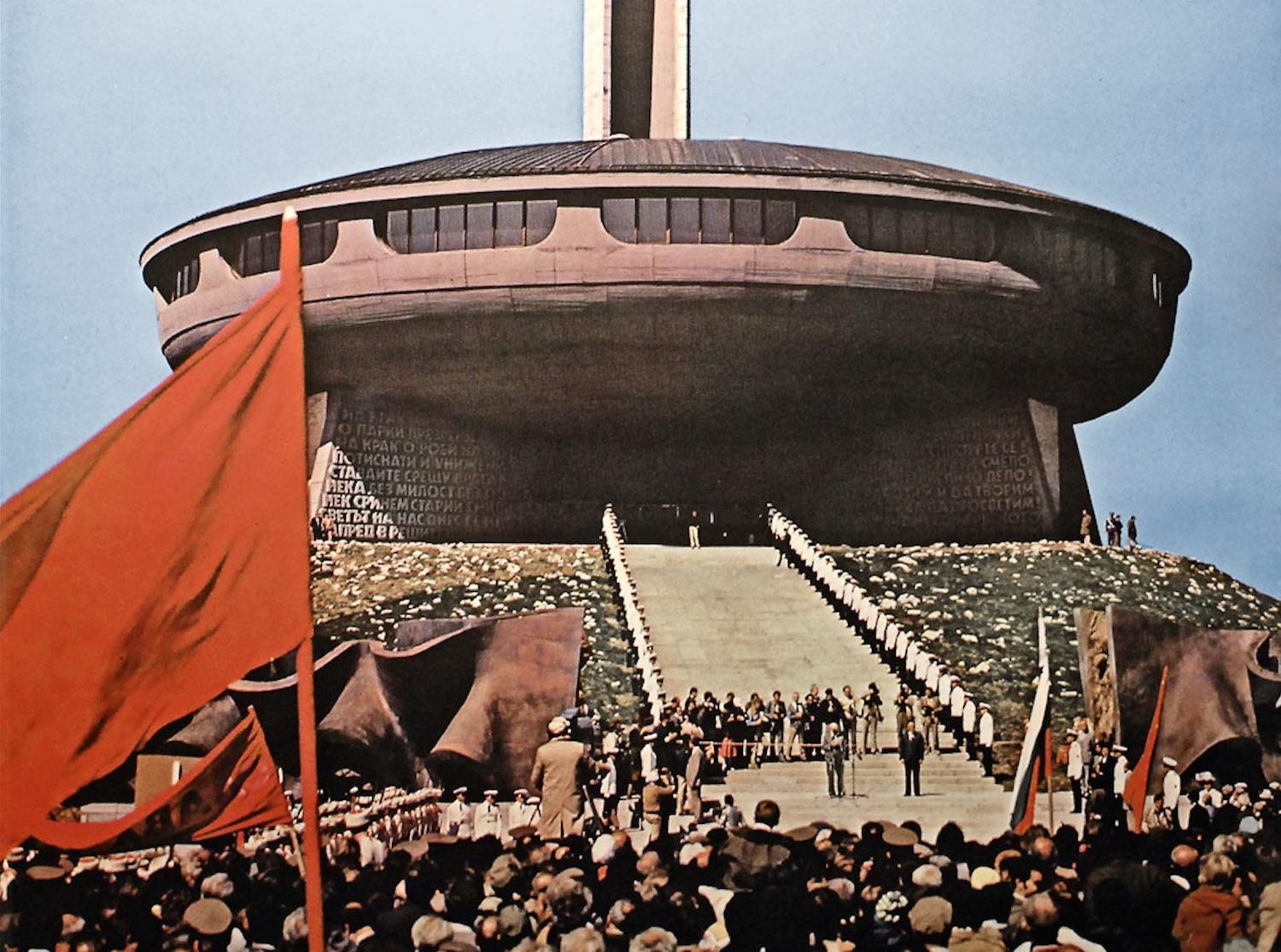
Todor Zhivkov, Secretary General of the Bulgarian Communist Party, declared at the opening ceremony of the Buzludzha Memorial House on 23 August, 1981:
“I am honoured to be in the historical position to open the House-Monument [of the Bulgarian Communist Party], built in honour of the accomplishments of Dimitur Blagoev and his associates; who, 90 years ago, laid the foundations for the revolutionary Marxist Party in Bulgaria. Let the pathways leading here – to the legendary Buzludzha Peak, here in the Stara Planina where the first Marxists came to continue the work of sacred and pure love that was started by Bulgaria’s socialist writers and philosophers – never fall into disrepair. Let generation after generation of socialist and communist Bulgaria come here, to bow down before the feats and the deeds of those who came before; those who lived on this land and gave everything they had to their nation. Let them feel that spirit that ennobles us and as we empathise with the ideas and dreams of our forefathers, so let us experience that same excitement today! Glory to Blagoev and his followers; those first disciples of Bulgarian socialism, who sowed the immortal seeds of today’s Bulgarian Communist Party in the public soul!”


3.7. The Monument in Use (1981-1990)
The Buzludzha Memorial House enjoyed almost a decade of use. Along with the many other memorial complexes around Bulgaria, it served as part of a network of educational heritage sites; though its size and complexity would set it apart as the jewel in the crown. The Bulgarian people had paid for the construction of the monument – many had volunteered labour too – and so entry was free for everyone. Due to demand however, visits had to be booked in advance. Many visits were arranged by schools or employers, and a great many people visited the monument: more than two million during its eight years of use. The architect Georgi Stoilov claims the building could handle as many as 500 people per hour on busy days (Appendix 3). When it wasn’t functioning as a public museum, the Buzludzha Memorial House was used as a venue for certain events by Bulgarian Communist Party. Award ceremonies were held here, and foreign delegations were often taken on a tour of the BCP’s extravagant monument to Bulgarian socialism.
By August 1987, six years after opening, a total of 1,426,597 people had visited the Buzludzha Memorial House (Minard, 2018), giving an average of approximately 238,000 visitors per year in that time, or approximately 650 visitors per day. These visits were recorded according to the various categories of tourists, as follows.
| Category of Visitors | Total | Proportion |
|---|---|---|
| Workers | 450,000 | 31.5% |
| Collective farmers | 190,000 | 13.3% |
| Employees | 365,000 | 25.6% |
| Students | 294,000 | 20.6 % |
| Military personnel | 55,700 | 3.9% |
| Pensioners | 26,000 | 1.8% |
| Foreign delegations | 13,400 | 0.9% |
| Foreign tourists | 29,400 | 2% |
| Total | 1,426,597 | 100% |
The Buzludzha Memorial House remained in use until 1989; however, following the beginning of the Changes, it would soon become apparent that the monument’s fate was inextricably linked to that of the Party which built it.

4. Post-Communist Decline
4.1. The 1990s
In the years that followed Bulgaria’s transition to democracy, many interventions were made to remove communist symbols and monuments which appeared in population centres such as Sofia; but the relatively remote location of the Buzludzha Memorial House ensured that this monument would, initially, go largely unmentioned in such discussions. However, it did see one act of iconoclasm, in 1992, just shortly after the trial of former leader Todor Zhivkov – as the new leaders of the Party had Zhivkov’s face removed from the mosaic wall inside Buzludzha’s Ritual Hall, in an effort to distance the Party from his legacy (Minard, 2018). The monument was officially closed and ceased welcoming visitors in 1990 (except by special arrangement), it was nationalised in 1992, and it remained guarded up until 1995; but after this point the guards were dismissed, and the building was left open and deserted. During the economic chaos and hyperinflation that beset Bulgaria in the mid-1990s, Buzludzha became the target of vandalism and looting. For some, it was perceived as an emblem of the regime responsible for the country’s current hardships, and so acts of violence towards this monument took on a symbolic quality. For many others however, it simply became an attractive source for valuable scrap – as Bulgaria entered triple-digit inflation, many citizens who had previously donated to the creation of the Buzludzha Memorial House would return now to Buzludzha Peak, taking back their investment in the form of stripped marble slabs and copper cables. Some visitors, believing the red stars in the tower were made from real rubies, shot them out with rifles – only to get showered in shattered, and worthless, synthetic ruby glass. Bedros Azinyan, a photographer and archivist whose father Artin Azinyan had been documenting the monument since its construction in the 1970s, laments how “the people destroyed the people’s monument” (cited in Nikolova, 2020). According to Stoilov however, the most severe damage done to the monument was caused by government employees, who Stoilov believes were amongst the first to loot the site for valuable materials. Most notably, the thick copper ceiling which had been installed above the Ritual Hall, carried a significant value, and was amongst the first features of the monument to disappear.
“The destruction was primarily caused by the government of that time. When Ivan Kostov became prime minister, he dismantled the whole country… dismantled our industry, all the factories, all industrial zones, Sofia’s western and eastern industrial zones. These were gigantic complexes and everything was utterly dismantled. Naturally, much of this was done out of spite toward the previous regime. I am not sure what Kostov did beforehand, he was probably nobody – but during this period he went on a rampage. He sent organised bands from the UDF [political party] to Buzludzha, and you can see the evidence there… the roof was damaged by explosions in an effort to remove all the copper. It could not have been destroyed like that otherwise” (Georgi Stoilov, Appendix 3).
Elsewhere, the architect has therefore summarised:
“Buzludzha is an epitome of Bulgaria. Externally, when [seen] from outside, it seems strong and steady but internally, while one is inside – it is falling apart” (cited in Minkovska, 2015).

4.2. Ownership of the Monument
The Buzludzha Memorial House was built by the Bulgarian Communist Party. After the Changes, the BCP rebranded as the Bulgarian Socialist Party, and they retained ownership of the monument until 1992, when it was officially nationalised by the new, democratic Bulgarian government. However, as the monument increasingly fell into disrepair under state ownership, the BSP continued to express an interested in reclaiming ownership – and in 2011 the BSP leader Sergei Stanishev sent a formal ownership request to the government (Trifonova, 2011). This application was provisionally approved on 30 September 2011, albeit with the government’s condition that the BSP would own the monument, but not the land beneath it (Mladenova, 2020). This condition would make conservation work difficult, as the BSP would be unable to change or develop the site without applying for approval from the Council of Ministers each time. As a result, no final ownership contract was agreed, and the monument remained under the de facto possession of the state, managed by the regional governor of Stara Zagora province (Morten, 2017). Despite insistence from the BSP that the state should take more action towards maintaining the site, no work was undertaken and the condition of the monument continued to deteriorate (Vukov, 2012).
In June 2017 the BSP made another legal application for ownership, with the Socialist MP Krum Zarkov proposing that: “The first and foremost thing is to stop the decay because the monument is in a horrible condition” (cited in Morton, 2017). However, the terms of such a transfer would now be subject to a new Bulgarian law, which had been passed in February 2017 – and which made it impossible for state property to be given freely to private individuals or organisations (Morten, 2017). Rather than receiving the monument freely therefore, the BSP would need to either buy the monument from the state outright, or else it could apply to manage the Buzludzha Memorial House for a 10-year period, after which time ownership would automatically revert to the Bulgarian state. During these 10 years, as per the new law, the BSP would be unable to use the monument for commercial purposes (which would limit the potential for events and functions that might otherwise have helped in raising the funds necessary for any kind of restoration plan). The BSP submitted their application for a 10-year custodianship of the site on 16 June 2017, but it was rejected by the state in early July: with seven government representatives voting in favour of the transfer of the monument, and twelve against. This rejection was said to be made in large part due to the BSP’s lack of any clear plan for the future of Buzludzha, and their failure to present written documents evidencing a consideration of purpose, costs and timeframe for a conservation project, or any evidence that they had the necessary funding to achieve such outcomes. Allegedly, this lack of clarity resulted in part from division amongst the socialists themselves – with some members of the party believing the monument should be comprehensively restored to its original, lavish condition, and others arguing in favour of a reimagining of the site as a contemporary museum to the Bulgarian, or even the global, socialist movement (Morten, 2017).
To date, all post-communist ownership bids have been unsuccessful, and the monument remains the property of the Bulgarian state, though its status is simply that of a ‘building’; as since the transition to democracy, the Bulgarian Ministry of Culture has not yet recognised the Buzludzha Memorial House as having sufficient cultural significance to be granted ‘monument’ status.
This chapter is an excerpt from:
Fawcus, R. (2022). The Buzludzha Memorial House and the precarious fate of communist monuments in post-communist space (pp. 191–215) [Doctoral dissertation, University of Central Lancashire]. Lancashire Online Knowledge.
References
Blagoev, D. (1971) Articles (pp. 79–85). Sofia: Bulgarian Writer.
Hristov, I. (1991) The Detachment of Hadzhi Dimitar and Stefan Karadzha (pp. 27–31). Sofia: Specter.
Minard, A. (2018) Bouzloudja: Crépuscule D’Une Utopie [Buzludzha: Twilight of a Utopia]. Paris: Éditions B2.
Minkovska, S. (2015) (Never) Forget Your Past [MA dissertation]. Royal College of Art, London.
Mladenova, J. (2020, 6 August) Възстановяват мозайките в Паметника на Бузлуджа [They are Restoring the Mosaics in the Buzludzha Monument]. Za Kazanlak. zakazanlak.bg
Morton, E. (2017, 27 June) Will the Socialists reverse the fortunes of Bulgaria’s “UFO” monument? The Calvert Journal. calvertjournal.com
Nikolova, M. (2020, 21 April) Saving Bulgarian Communism’s “Concrete Spaceship.” Jacobin. jacobinmag.com
Noev, S (1989) Memorial House on Mount Buzludzha. Sofia: September.
Stoilov, G. (2018) Georgi Stoilov: With a Vision for the Future. Sofia: Zachary Stoyanov Publishing House.
Trankova, D. & Georgieff, A. (2020) A Guide to Communist Bulgaria. Sofia: Free Speech International Foundation.
Trifonova, P. (2011, 28 September) Правителството даде Бузлуджа на БСП, но без върха [The Government Gave Buzludzha to the BSP, But Without the Peak]. 24 Chasa. 24chasa.bg
Todorov, S. (2020, 2 October) Neidentificiran Arhitekturen Obekt [Unidentified Architectural Object]. Kapital. capital.bg
Vukov, N. (2012, 5 December) The Museum of Socialist Art in Sofia and the Politics of Avoidance. Cultures of History. cultures-of-history.de
Yuroukov, I. (ed.) (1991) Georgi Stoilov & Partners. Italy: Arterigere.